


PHOTOS:
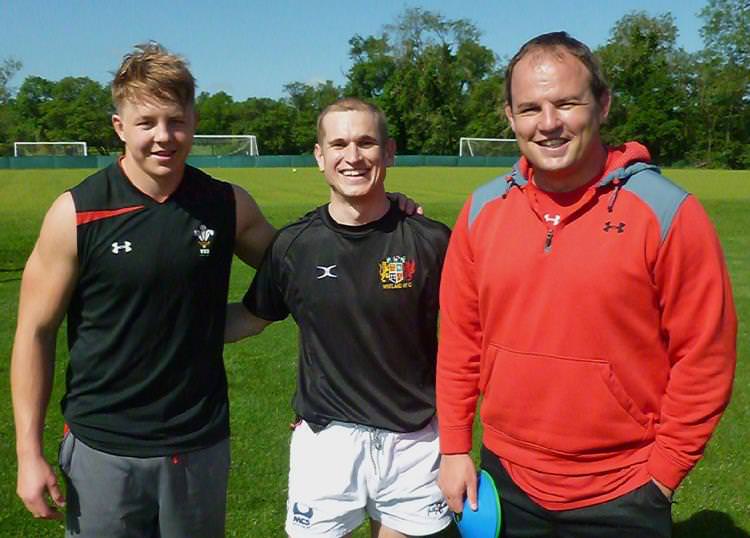
James Davies, Fraser and Gareth Williams
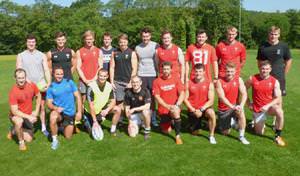
Fraser and the Welsh Sevens' squad
Has Gareth Williams spotted something in our boy?
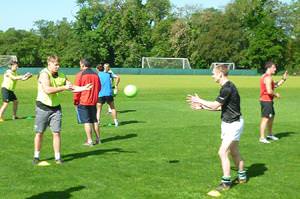
Fraser & James 'Cub' Davies practise a drill
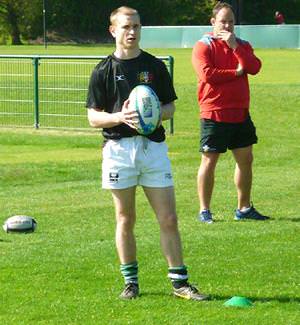
Watson on the burst
 Surely, rugby life can’t get much better than the IRB World Series, which links playing international rugby combined with countless trips to exotic locations – all in the name of a few brisk 14 minute matches which require little more than the occasional dart of pace.
And lest we forget, there’s also the after tournament socialising, which is renowned for its intensity in terms of partying that would rival the playing of any sevens rugby match.
Totally different picture
Of course, those who know better will correctly treat such statements with disdain, and a trip to the Vale of Glamorgan with Bill Carne for a session with the Wales Sevens squad for my thirteenth Commonwealth Games challenge confirmed what I already knew.
Namely, that such ignorance helps form one of the most common misconceptions in rugby union because the game of sevens has become a code in its own right, with the IRB World Series, that originated in 1999/2000, consisting of nine different meetings at venues across the globe.
In Wales, the game enjoyed a sudden hike in exposure in 2009, when the country stunned onlookers by winning the sevens equivalent of the Rugby World Cup in Dubai, beating Argentina 19-12 in the final.
Current squad are pushed so hard
And the current squad, soon to be cut to 12 for the Commonwealth Games, is training on a daily basis, starting at 7am and finishing around 2pm.
“We are aware we have a chance to make history in Glasgow,” said head coach Gareth Williams, who took over from Paul John in January after serving as assistant coach since 2008.
“No Welsh team has ever won a Commonwealth Games medal. We are aiming to qualify for the latter stages, which is a realistic goal if we get our preparation right.”
And such preparation will leave no stone unturned. Each training day incorporates a speed and power session with fitness coach Wayne Proctor, video analysis, a skills session, and weights, whilst injured players will attend physio and undergo their own fitness training.
Boys become men on tour
Traditionally, countries have used sevens as a breeding ground for youngsters with raw potential, with Justin Tipuric and Alex Cuthbert as two significant names to emerge from time in the shorter form of the game with Wales.
“In these tournaments you are facing players of international calibre in front of 60,000 plus people,” said Gareth, who also serves as head coach of Crymych RFC in Division One West.
“Boys become men on the circuit.”
But as he explained, sevens also provides an opportunity to re-invigorate careers, as well as develop them.
“You have to be realistic and players who are first choice of their regions will always struggle to commit to the IRB World Series.
“So it’s not just a young man’s game – there is room for players with vast experience and talent.”
Skipper Adam leads by example
One player with such qualities is captain Adam Thomas, who will join the Cardiff Blues next season after several seasons of combining sevens commitments with playing for Pontypridd RFC.
“In terms of fitness it’s a massive step up from the 15-a-side game,” he said.
“And until you have tried it you don’t realise. It can be frustrating when people try and portray sevens as a jolly – at international level you have to stay in top shape the whole time and we are both fat-tested and fitness tested regularly.
“It’s a tactical game but at the same time, it’s extremely tough on the lungs.”
Indeed, Adam admits that after his first Wales session in 2010, his legs felt like ‘jelly’ a few days later when he lined up for Ponty to play Newport RFC.
“I will never forget that,” he said.
“It’s a different type of training here and my first time really hurt me.”
Fraser joins the sevens’ fray
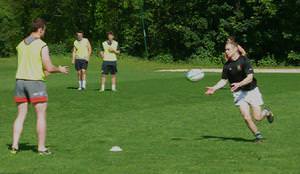
Not half as much, I suspected, as my first time was about to hurt me as I joined the squad for a skills session under the guidance of coach Barry Maddocks.
However, a few sporadic appearances for the ‘Wales’ Academicals and Crawshays teams aside, I knew the next hour would represent the closest I would ever get to the international involvement we all dream about as youngsters.
It began with a series of hand eye co-ordination drills with tennis balls, and I desperately tried not to look out of place after being paired with Lee Williams – a member of the afore mentioned World Cup winning squad in 2009.
I decided against introducing myself as someone who had frequented the annual Pembrokeshire sevens gathering in Newport.
Pace and precision aplenty
The session then developed onto handling and possession based games. What struck me was that on paper, the drills would have appeared relatively simple. But the pace and precision with which they were executed at, was anything but.
Indeed, trying to keep up with the sharp turns and constant movement off the ball left me breathless in the blazing sunshine.
But at the same time, I was given an interesting insight into the intricacies involved at that level.
For the majority of us, a dropped ball or misplaced pass in training represents a mistake.
But in this session, such blatant errors were a distant concept. Players were constantly reminded about footwork, posture, and handling positions – and exercises were executed with speed and accuracy.
Expert analysis of session
Furthermore, all sessions are filmed and then analysed – so there is no room for switching off or a drop in standards. And there is certainly no room for a drop in intensity, with little rest or reprieve between drills.
Training culminated with work on depth and passing, and despite failing in my attempts to remain tucked away on the safety of the wing – I did manage to at least avoid any fumbles.
And on a serious note, the session proved an eye opening experience for me, emphasising the game was about so much more than the much heralded fitness components of power, pace, and endurance.
“The biggest difficulty in sevens is coping with the extra space,” said Gareth afterwards.
“It’s surprising how many good players are unable to use the ball in space – it highlights decision making and exposes people.”
And finally . . .
The sevens circuit will continue to grow, and the Commonwealth Games should provide the public with a chance to appreciate the manner in which the game has developed.
For it is now about so much more than the odd side-step or burst of pace. It’s about technical ability, decision making and physicality – not to mention dedication to training and extreme levels of fitness.
And those who cannot appreciate that – are not true followers of rugby union.
Watson’s ‘Coals to Newcastle’ job by Bill Carne
As Fraser Watson and I turned off the M4 at Junction 35 there was a real air of anticipation.
We were now only minutes from the WRU’s centre of Excellence at The Vale, where we were to meet up with Gareth Williams, the coach to the Welsh Sevens team in the Commonwealth Games, and a squad of some 20 players all vying for inclusion in that 12-man squad.
Now for Fraser, who plays on the wing at Whitland RFC, this was the Commonwealth Games Challenge that he relished above all others (no disrespect to the other 16 sports but this was a real ‘Coals to Newcastle’ job.
It gave him the chance to rub shoulders with players in the peak of condition and with a target that sets them apart; even more exciting than being with the Welsh squad for the World series which took some of them to Dubai, Hong Kong, Japan, New Zealand, Australia and South Africa, to name but a few.
We had left Haverfordwest at 7am and it was at that time the squad had also started out on their training, which they do every weekday, other than a break on Wednesday.
These included James ‘Cub’ Davies, who hails from Whitland RFC and was voted ‘Welsh Sevens Player of the Year’ as reward for his all-action play in 2014, playing in his last competition before reverting to the 15-man game at the Scarlets for the 2014/15 campaign.
Then there was Lee Williams, the play-maker who is very nippy and a great reader of the game, and Adam Thomas, who hails from Ynysybwl, near Pontypridd, and has previously enjoyed leading the Welsh Sevens in the World Cup as another competition to savour.
Leading the way in training is Gareth Williams, who doubles up as head coach at Crymych, with former Scarlets and Wales’ winger Wayne Proctor in charge of fitness and Stefan Thomas (ex-Carmarthen Quins as new team manager).
They all make Fraser and I welcome, with ‘Cub’ his usual brilliant self as he escorted us out from the indoor rigours of a fitness session and then the study of a video which outlined what the coaches were looking for in the next session, down onto the wonderful turf where the skills session took place and Fraser was allowed to take part.
The weather was perfect and something that struck me was the attention to detail, with correct passing as the focal point of this hour-long session. It was all done at pace but to Fraser’s credit he settled in once he had adapted to that pace of movement and passing.
Rugby balls were used but the squad also used footballs and tennis balls in handling practice, as well as a competition element to see who could put into practice what they had been working at. I thought Fraser did well here in one to one exercises which were rotated at quite a speed.
They were all ready to chat to us and be interviewed and it was a revealing morning where captain Adam Thomas told us how hard it had been to raise his fitness levels when he converted to the sevens’ scene.
Care with nutrition and general fitness are key issues and players are regularly tested to make sure they are on the straight and narrow.
By then the squad had been working for over three hours and after breakfast they were allowed a rest period and then weight training as part of their daily schedule.
It was absorbing to watch and my only grumble was the fact that whilst I was all for mingling even further over that breakfast, which contained mounds of good grub, Fraser had decided he needed to get fitter and off we went, back down the M4 on the way home.
It was easy to see how inspired Fraser was with what we had seen and both of us hope that the Welsh Sevens’ squad can become the first group in any sport to ever bring a team medal of any colour back from a Commonwealth Games.
They face a real challenge as some sides have strengthened with star players (like Bryan Habana playing for South Africa) but if hard work, fitness and real dedication to the cause are anything to go by then they must have a chance!